
How to Search Ripley Criminal Dockets
Missouri Case.net is the first public stop for a Ripley County criminal docket. The statewide tool documents searches by case number, litigant name, filing date, and scheduled hearings. A case number gives the cleanest start. With only a name in hand, use the spelling on the charge or notice, then compare the county, division, category, parties, and most recent event before trusting a result as the right Ripley County criminal case.
Remember what Case.net is. It works as an index and status tool. A brand-new filing, a related municipal transfer, or a restricted file may not appear right away. Jot down the public case number and the date of the last event. The Ripley County clerk can use those details to pinpoint the criminal docket. That works well when an online result seems thin. Skip sensitive identifiers as search terms. Stick to the case number, name, filing-date range, and scheduled-hearing routes the court provides.
- Open Missouri Case.net and begin with the exact criminal case number when it is available.
- If no number is known, search the defendant name and narrow the result to Ripley County and the matching case category.
- Check the case header, current status, last docket entry, and any future setting before relying on a result.
- Use the scheduled-hearings search for a setting, then confirm a changed or urgent date with the clerk.
- Ask the clerk for a docket sheet, judgment, or certified disposition when a copy beyond the public index is needed.
Ripley County Criminal Case Numbers
Missouri's Court Operating Rule 4 keeps a separate criminal file for each defendant named in a complaint or information. So Ripley County criminal docket numbers can differ. A search for one person may surface a related matter. That never replaces checking the exact case header for each defendant. Older and converted files may also differ. Their numbering construct can be unlike a current automated record.
Copy the number exactly as Case.net shows it, such as the live Case.net case number. Do not guess a local prefix or sequence. In lower-level traffic and infraction matters, a uniform citation can serve as the file number. A serious traffic charge may draw a fuller criminal docket. A municipal matter can gain a related number too. That happens when it moves into the associate or circuit division. The Court Operating Rule 4 recordkeeping rules are the statewide source for these distinctions.
Note: A shared name, citation, or charge does not prove that two Ripley County criminal dockets are the same file.
What Ripley County Criminal Dockets Show
Think of a Ripley County criminal docket sheet as the case's timeline. It logs filings and court actions in order. Court Operating Rule 4 also treats the docket or backer sheet as part of the official record. The case header identifies the court, county, category, parties, case number, and status. Entries follow with dates of filings, settings, motions, orders, pleas, and other events. Read each entry alongside its date. Check any public linked document too. Do not treat one line as a stand-alone summary of the whole case.
| Case header | Identifies the Ripley County court, case number, parties, category, and current status. |
|---|---|
| Charge fields | Can distinguish the charge filed from the charge at disposition. They are not always the same. |
| Settings | May show an appearance, arraignment, motion hearing, trial, or later court date. |
| Filings and orders | Show requests and judicial actions. A motion is a request, not proof that it was granted. |
| Judgment or sentence | Shows a final action when entered, but a signed record may provide the controlling detail. |
A warrant entry is not a copy of the warrant itself. An attorney-of-record line can shift after later docket activity too. For a particular Ripley County criminal docket, the clerk can explain whether a public electronic document, paper file, plain copy, or certified record is available.
Ripley County Criminal Law Day
The official Ripley County court listing sets Wednesday as Division II criminal law day. That recurring notice gives useful context. It helps when a Ripley County criminal docket entry references a setting in the associate division. Still, it is not a full daily calendar. It does not promise any particular case will be called on the next Wednesday.
Before an actual appearance, set the docket entry beside the mailed court notice. Then verify date, time, division, location, and appearance method with the clerk. Hearings get continued, vacated, sealed, or posted after an index refresh. The same listing also gives Division I separate law-day and term-day notices. Do not assume those govern Division II criminal settings. That goes for municipal sessions too.
Stages on Ripley County Criminal Dockets
A Ripley County criminal docket often opens with a complaint, information, indictment, or authorized citation. From there, the record may show summons or warrant activity. It may also show an initial appearance, counsel, arraignment, motions, and later trial or plea events. The order shifts with the charge. It also shifts with the court's directions. Treat a listed charge as an allegation at filing, not a disposition. For the final legal result, read the judgment, disposition, or other controlling order.
Docket flow: Filing → appearance or arraignment → motions and settings → plea or trial → judgment and sentence.
A disposition can take many forms. Dismissal, plea, verdict, judgment, diversion, or another authorized outcome all qualify. A sentence may carry conditions a short docket label leaves out. When the wording matters, request the signed public order. Do not infer the result from one brief event line.
Ripley County Serious Traffic Dockets
Not every Ripley County traffic ticket stays a simple paper matter. Court Operating Rule 4 lists serious offenses handled with the core elements of a full docket. Examples include DWI, BAC, driving while revoked or suspended, leaving the scene, and fleeing or eluding. So one citation can grow into criminal filings. Expect settings, counsel entries, judgment, sentencing, and later compliance events in the record.
Begin with the citation number if the ticket shows one. Then search by name and ask whether the matter carries a related criminal case number. A case may sit with a city municipal division. The associate division or the circuit court may also hold it. Each follows a different path. For the criminal proceeding itself, the court docket is the source. Separate law-enforcement or state agency records do not replace it.
Which Court Holds Ripley County Criminal Dockets
The Circuit Court of Ripley County, 36th Judicial Circuit, Missouri, keeps the main trial-court record. The county listing shows Division I and Associate Circuit Court Division II. Associate proceedings can include misdemeanors, traffic, and other matters assigned by law. The exact forum for any criminal case turns on its charge and posture. Doniphan and Naylor municipal divisions handle city-ordinance and municipal-traffic matters at the Ripley County Courthouse.
One courthouse does not mean one interchangeable docket. Search the case category and division shown in Case.net. The original citation may not locate the later record. In that case, ask the clerk about a municipal transfer or trial de novo. A state appeal from the Ripley trial court is searched separately through the Missouri Court of Appeals, Southern District. It is not a new local trial docket.
Ripley County Criminal Clerk Requests
Case.net can fall short. When it does, the circuit clerk is the practical local contact for a Ripley County criminal docket, a public document, a paper file, an ordinary copy, or a certified judgment. Some public electronic documents may require the courthouse terminal. The Missouri Judiciary's File Viewer Help describes ECASE and public-document access. The Missouri eFiling System gives attorneys and authorized filers a different secure route.
Ripley Circuit Clerk
Ruth Austin, Circuit Clerk and ADA Coordinator
100 Courthouse Square, Suite 4
Doniphan, MO 63935
(573) 996-2818
Associate division: (573) 996-2013
Fax: (573) 996-5014
Email: ruth.austin@courts.mo.gov
Give the clerk the case number. Add the defendant, the document sought, and the docket date. A paper or certified request can be made in person, by mail, or by fax. Before sending it, confirm whether the clerk accepts email requests. Ask about copying, certification, payment, and mailing requirements too.
Public Access to Ripley County Criminal Dockets
Public access to a Ripley County criminal docket has limits. Court Operating Rule 4.24 through 4.26 cover confidential, sealed, and expunged court records. Presentence investigations, probation or parole material, treatment-court records, juvenile records, mental-health matters, and other protected material stay closed. A criminal case still exists. Even so, those files stay shut. A public case header can remain visible. An attachment may still be unavailable.
Access rules matter. RSMo §509.520 limits public display of specified personal identifiers in court filings and orders. RSMo §211.321 provides a separate confidentiality framework for juvenile records. RSMo §610.140 makes expunged court records confidential as the statute allows.
The official privacy statute shows why a public criminal docket must not reproduce full protected identifiers. A Ripley County criminal docket can still give useful court history without exposing private data.
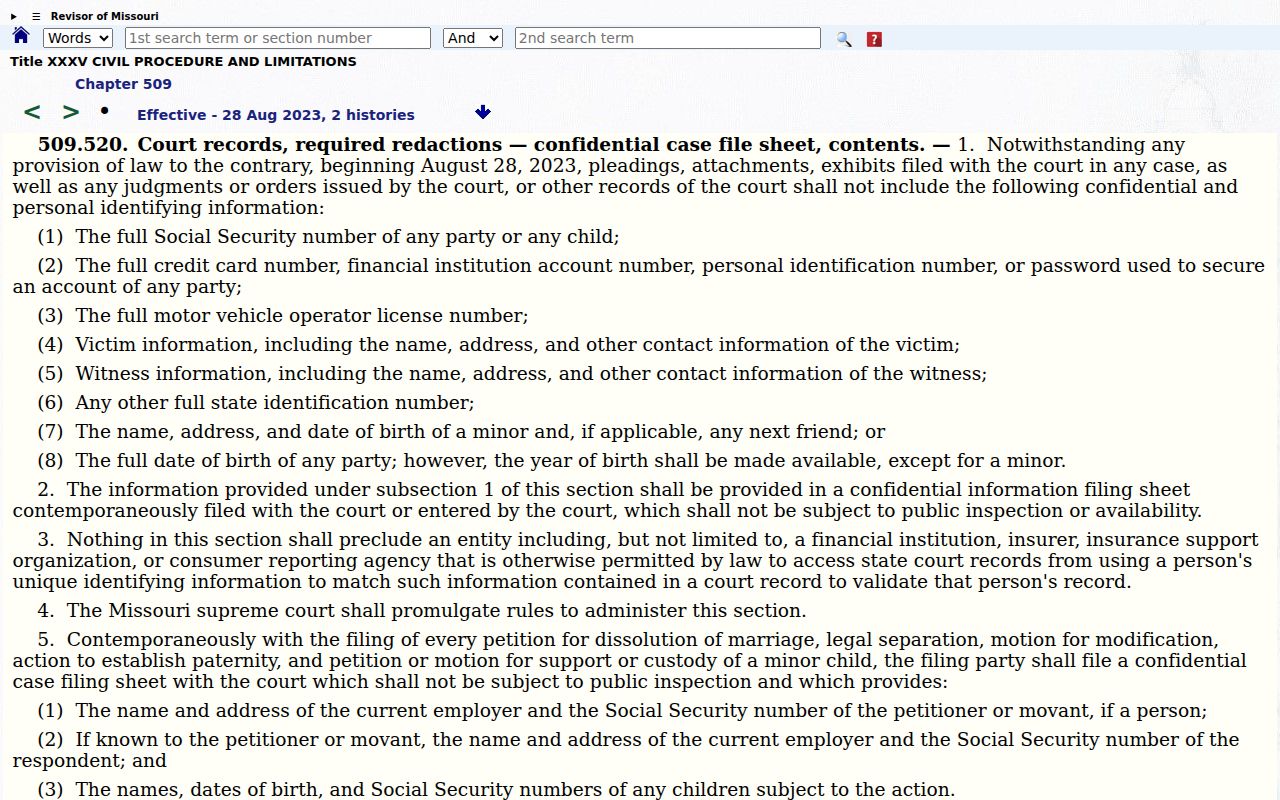
Redaction rules shape how anyone reads public court records. The official juvenile-record statute explains why. Juvenile material is not searched like an adult Ripley County criminal docket.
That bar holds even when a public user can locate related adult court information. The official expungement statute is the source for the confidentiality rule. It can remove a case from ordinary public access.
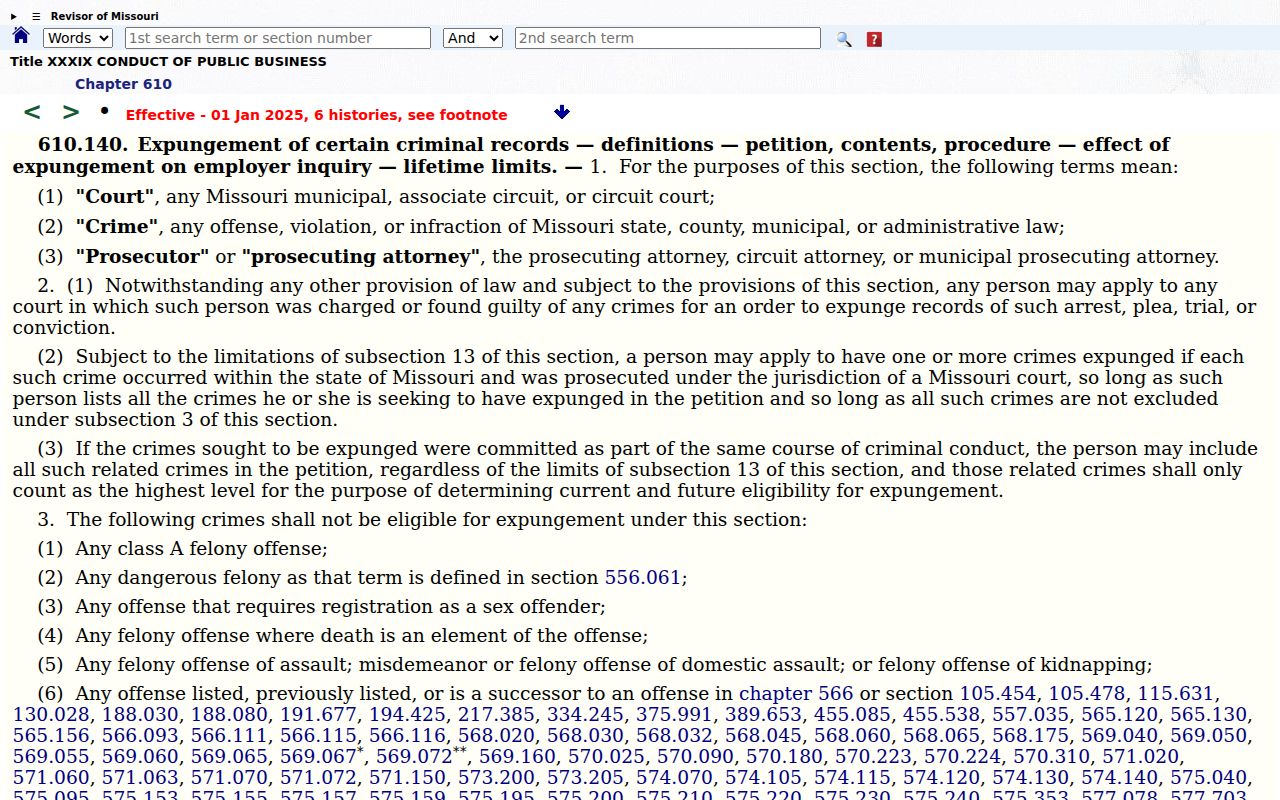
A missing public result does not prove that no criminal case ever existed.
Ripley County Criminal Appeal Path
A criminal judgment entered in Ripley County can move past the local trial docket. The route runs through the Missouri appellate process. The intermediate court is the Missouri Court of Appeals, Southern District. It lists Ripley County in its jurisdiction. An appeal carries its own appellate record and number. The local criminal docket may reflect the notice of appeal or related action. It is not the complete appellate docket.
For a Ripley County criminal matter still at the trial stage, use Case.net and the clerk's office. For an appeal, check the Southern District's official information and the appellate case record. Keeping the records straight avoids mistaking a later appeal for a new criminal filing in the county court.